
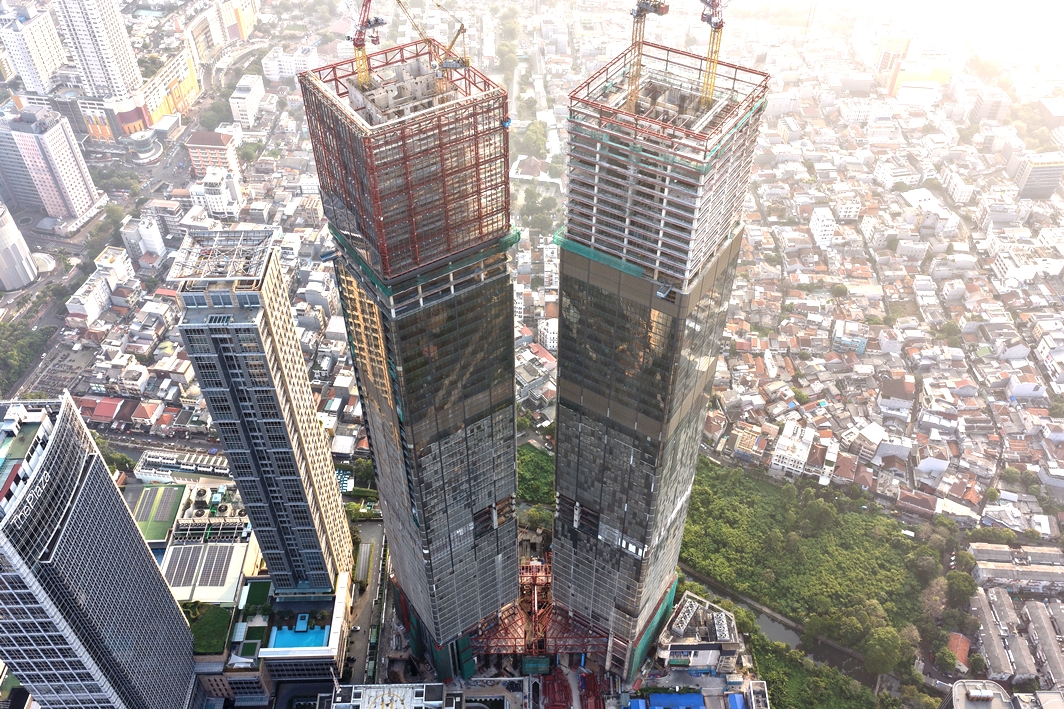
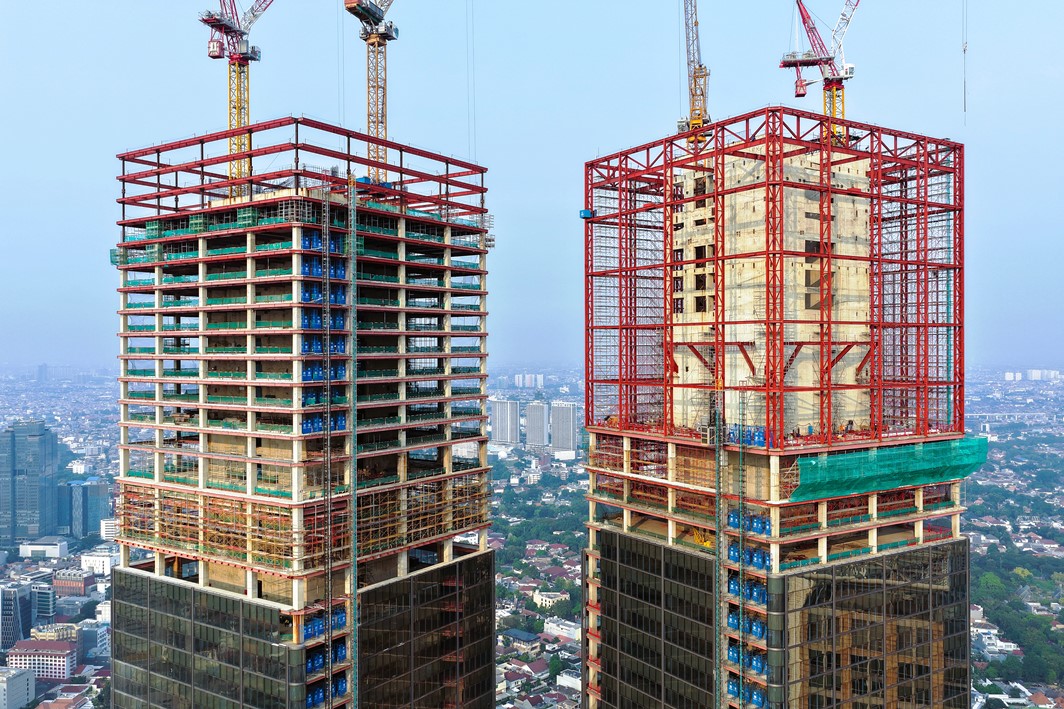


After a prolonged suspension of construction, the Indonesia-1 project resumed construction in 2025 and is now approaching an important topping-off milestone. As one of Jakarta’s most prominent mixed-use twin-tower developments, the project is undergoing a large-scale adaptive reuse that transforms a significant portion of its original office space into high-end apartment units, hotel, and serviced apartment facilities.
Located in Jakarta’s Central Business District, adjacent to Plaza Indonesia and behind the Embassy of Japan, Indonesia-1 rises more than 300 metres above a 19,000-square-metre site. The development comprises approximately 310,000 square metres of gross floor area, including premium office space, luxury residences, hotel and serviced apartments, retail facilities, and seven basement levels for parking and building services.
The project is also significant as one of Indonesia’s most advanced high-rise developments designed by Indonesian engineers from concept design through to construction drawings. With its scale, complexity, and adaptive reuse strategy, Indonesia-1 is set to become the largest adaptive reuse projects in Indonesia to date.
Following the suspension period, the project underwent a major redesign to accommodate revised commercial objectives. The South Tower was converted from an office tower into a luxury residential tower, while the North Tower retained its office function, with hotel and serviced apartments occupying the upper levels. This change in occupancy required extensive structural reassessment and optimization to accommodate the revised loading criteria while minimizing structural strengthening works, preserving the existing construction, and maintaining the targeted project schedule.
Construction is currently progressing on the Lower Sky Bridge, a three-storey bridge located at Levels 3, 4, and 5 that physically connects the two towers. Upon completion of the Level 5 slab, the bridge deck will serve as a temporary assembly platform for the Upper Sky Bridge. The Upper Sky Bridge will be fully assembled at the lower elevation before being hydraulically jacked into its final position, spanning Levels 20, 20 Mezzanine, and 21. This innovative erection methodology enhances construction safety and quality while reducing the risks associated with high-level assembly.
The Upper Sky Bridge itself is one of the project’s most technically demanding structural features. Rather than functioning as a simply supported bridge, it is designed as two independent steel cantilever structures extending from each tower and connected at mid-span through a seismic joint. This configuration allows each tower to respond independently to differential movements caused by wind, seismic loading, creep, shrinkage, and long-term building shortening, while maintaining uninterrupted pedestrian connectivity between the two towers.
The longest cantilever extends approximately 27 metres, making it one of the longest cantilevered sky bridge structures incorporated into a high-rise building development in Indonesia. The combination of long-span cantilever construction, seismic articulation, adaptive reuse, and hydraulic jacking erection reflects the project’s advanced structural engineering and construction capabilities.

